The Northern Empire
Divine Tharena! What a sight for sore eyes. Once you held the world in your palm and ruled with an iron fist. Now your past glories shine only upon us that live in your shadow. Beyond your walls the Empire grows and prospers and strays and plays host to a manifold of cultures and beliefs. Pray tell me, Divine Tharena, how your ancient glory might be restored to true power?
– From an extensive speech in defense of an accused murderer, written by Caius Orenicus the Younger, Tharenan orator, playwright and imperial senator
The Northern Empire, styling itself as the Divine Empire of Tharena, is the transformed legacy of the Tharenan Empire that in ancient times conquered much of the known world. Now it plays host to a diverse nation mixing cultures old and new, foreign religions, and a powerful aristocracy keen to assert their power against the imperial court. A land of ambition, big and small, where a lowly peasant might rise up to usurp the throne and become empress, but is far more likely to be trodden into the ground in service to her liege lord.
History
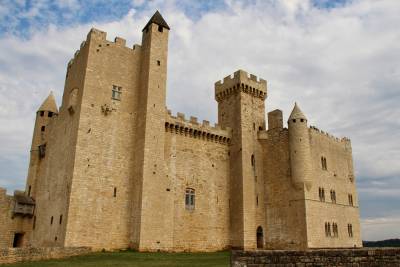 The split in the Tharenan Empire was officially recognised when the usurper Iulia Rugula, a Muella lowborn soldier, was acclaimed Empress by the 11th Legion, marched on Tharena and seized the throne in a prolonged civil war. When the dust settled, the Southern Empire grudgingly acknowledged a non-dragonblooded Empress, but proclaimed itself the only rightful successor to the Tharenan Empire.
That was 400 years ago, and now successive dynasties, some Dragonblooded, some not, have sat on the Divine Throne — ruling from a network of imperial capitals established to manage the Empire's borders and the threats, both from outside invaders and internal usurpers.
The split in the Tharenan Empire was officially recognised when the usurper Iulia Rugula, a Muella lowborn soldier, was acclaimed Empress by the 11th Legion, marched on Tharena and seized the throne in a prolonged civil war. When the dust settled, the Southern Empire grudgingly acknowledged a non-dragonblooded Empress, but proclaimed itself the only rightful successor to the Tharenan Empire.
That was 400 years ago, and now successive dynasties, some Dragonblooded, some not, have sat on the Divine Throne — ruling from a network of imperial capitals established to manage the Empire's borders and the threats, both from outside invaders and internal usurpers.
The Northern Empire has often had to deal with migration across its northern borders and has variously fought off or settled these groups. The Thengi, Pathaans and Sathi have been the most successful of those settled, and have brought their customs, and sometimes religions, to the Northern Empire's lands and armies.
Over the last eight centuries, the old provinces have become powerful political entities in their own right, their Duchesses having their own ambitions, sometimes counter to that of the Empresses.
Governance
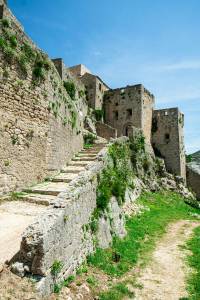 The Divine Empire of Tharena is ruled by a Senior Empress together with a Junior empress, the latter usually appointed by the former and often the designated successor. The Senior and Junior Empress often take opposite corners of the Empire to oversee, ruling from regional imperial capitals, commanding the imperial armies and cadres of war mages. The current Senior Empress is a Ssar named Callistian of the successful Petronian Dynasty.
The Duchesses are ostensibly answerable to the empresses, but in practice, those that rule the major provinces in Palonia, Corpunia, and Altalyria have extensive power, support from local senates and aristocracies, and command their own armies. They will band together to face the empire's enemies and problems, but are far more concerned with their own interests and ambitions.
The emergence of the Labyrinth is an opportunity both for the Northern Empire to assert its long-denied rule over the Southern Empire, and for ambitious Duchesses to further their plans for glory, recognition and maybe even the Imperial throne. Those below them are of course likely to be dragged into their political machinations.
Society and Culture
Ancient Tharenan names and titles used to be traditionally gendered (similar to Roman or Romance-language names) but this has largely fallen out of use in the Northern Empire. The convention is to use the feminine forms of titles exclusively. Thus, it is always 'Empress', whatever the gender of the throne's occupant.
Society in the Northern Empire is constantly evolving into new and interesting forms, but is always looking backwards to the glory days of Tharena. It helps that the Divine City itself is at the heart of the Northern Empire even if its political relevance has declined — it remains the cultural heart of Yulaia, the region around Tharena on the northern coast of the Inner Sea.
The major regions, with powerful local aristocracies and Duchesses include: Palonia, the first conquest of the Empire and home to the oldest landed families rich in history and culture; Corpunia, a harsh land rich in natural resources and home to a disproportionate number of usurpers of the imperial throne; Altalyria, former home of the conquered Lyrian Empire and the ancient Purdanism religion, is now the breadbasket of the Northern Empire.
The myth at the heart of society in the Northern Empire is that anyone can become anyone, but in truth this is used to keep the peasantry (and other social ranks) in their place. It is a romantic notion, but the reality of shifting one's social rank is daunting and difficult. That does not mean many don't try — some few succeed. Notably, almost all the imperial dynasties of the last 600 years have come through usurpation and civil war.
Characters from The Northern Empire
Starting Point: The most important consideration for a character from the Northern Empire is their ambition. Even a peasant who is realistic about the chances of becoming an Empress may still set their sights on a knighthood. What change does your character want to achieve for themselves and their corner of the world. Secondary to that, consider where in the Northern Empire you come from — the different provinces are different flavours of developing early medieval kingdom — and it matters where you came from. The Northern Empire is home to at least three major religions, and although The Unspoken Word is officially the state religion, Purdanism and Sathism rub shoulders with it — which religion does your character adhere to, even nominally?
In the world: Characters from the Northern Empire are likely to have an inflated view of themselves and their place in the world. The Northern Empire is mighty, but it is not what it once was, and the people of other states will recognise that it is not the undisputed power of the Inner Sea. All the better to seek your ambition outside Empire and show off its reach and power. There is a natural rivalry with the Southern Empire, but they are still considered closer kin and more civilised than other states.
Character Options and Suggestions: All species are represented across the lands (except the Slimefolk) and though the Dragonblooded no longer have a stranglehold either on the imperial throne or the aristocracy, they are more numerous (especially in Yulaia) than in the Southern Empire.
The tales of modern Tharenans include a great many archetypes, often associated with the different regions. You might be a mighty knight of Palonia skilled in Frontlining; an extravagant wandering adventurers of Corpunia skilled in Pathfinding; one of the myriad philosophers, theologians or thinkers or Altalyria with a love of Scholarship; an outlaw or chancer from the mountainous region of Kannum with a talent for Roguery; an unfortunate, temporarily embarrassed landowner, bounced between invasion and land dispute in battleworn Surimuutum relying on Diplomacy to get by.
Magic is widely used across the Northern Empire, typically to support imperial logistics when an Empress' court moves, repel threats at the borders or at the behest of Duchesses to deal with regional supply problems. A mage of any kind would easily find employ at a Duchess' court.
| Status Rank | Title | Position in Society |
|---|---|---|
| 1 | Peasant | Citizen of Tharena, though that means little these days. Likely tied to the land, or free to die in whichever city they were born. Still, as citizen, your ambitions may take you far. |
| 2 | Merchant | Of some privileged standing in the Empire's cities and with some small going concern in trade. |
| 3 | Knight | The lowest rung of aristocracy, but likely no more than the name of a landed family and no actual power except that procured at the court of the local countess or duchess, or perhaps minor service in the imperial court. |
| 4 | Countess | A title and the power that comes with it — you are bound to your family, and to a duchess, expected to improve the fortunes of the former and faithfully serve the latter. |
| 5 | Duchess | The hereditary governor of a whole province, your rule of said province is likely undisputed. You theoretically serve the Empress however, and they will expect you to do their duty if they or their councillors call. |
| 6 | Councillor | (Not available at game start) You have the ear of the Empress and hold an official high-ranking position in court. You help run and administer the Northern Empire and its many bounties. With such power, comes the expectation to fulfil the Empress's whims. |
| 7 | Empress | (Not available at game start) You are the senior or junior empress, answerable to nobody but yourself. Everyone below you wishes they were in your place. |
Naming Conventions
Traditional Tharenan names, as still predominantly used in Yulaia and Surimutum, are similar to Ancient Roman names in our world, and the overall convention is for either just a first name or first name and family name. E.g. Maxima Ignia, Honoria Juvata.
Regions have their own cultural divergences. In Palonia they are similar to French names in our world, Spanish for Corpunia, Persian for Altalyria, and Slavic for Kanuum.
Clothing Styles
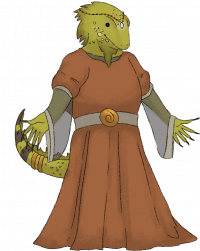 The general style of clothing in the Northern Empire is similar to the styles of Western Europe during Late Antiquity through to the Early Middle Ages (approximately 4th to 9th centuries CE). This typically is composed of tunics, often over trousers — these are either simpler, or more tailored to any individual body-shape (where expense permits) with belts, wrist- and arm-clasps also used. Increased social status is usually designated through jewellery, accessories, expensive dyes used in clothing and elaborate decorative elements.
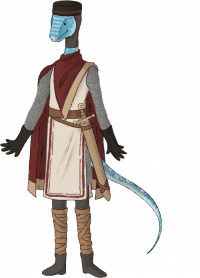 Cloaks are increasingly popular, especially in the colder provinces of Palonia and northern Corpunia. Layered and more elaborate tunic-dresses are the evolving fashion, moving away from what was considered traditional in the Tharenan Empire of old.
Military clothing favours primarily chainmail, across the body, arms and sometimes upper legs. Leather is also used, but typically by tribal troops employed by the empire. Some of the nobility and otherwise wealthy individuals also favour decorated breastplates, but larger ensembles of plate or scale are not used, especially in colder climates where additional layering is also necessary. Imitating ancient Tharenan military fashion is considered extravagant, but not unheard of, including large plumed helmets.
Notable NPCs
| Name | Pronouns | Species | Status Rank | Costume | Description |
|---|---|---|---|---|---|
| Harol the Black | he/him | Dragonblooded | 6 | Colourful coat and trousers | Slim, even a little scrawny for a dragon-blooded, fresh-faced, with light blond hair. A stylish dresser. Harol the Black is the Divine Empire's Lord Plenipotentiary to the Most Eminent and Reverent Order of Word-Keepers of the Temple of the Scale of the Guardian. He is the Senior Empress' chosen man to direct the Northern Empire's efforts in the Labyrinth and said to be their personal favourite at court. He is said to be very ambitious, though many also speak of his personal loyalty to the Empress. |
| Duchess Clemence de Lac | she/any | Ssar | 5 | Dress and symbols of office | An important dux of Palonia, imposing and impressive, green-scaled like most Palonian Ssar. She was instrumental in putting down a usurper during the previous emperor's reign and was rewarded with the position of the usurper. She now has ambitions to found a dynasty of her own in Palonia. Uncharitable whispers suggest that she wishes for Palonia to become more independent of the Empire; even more uncharitable whispers wish to proclaim her empress. Surely these are merely rumours. |
| Lady Corin Mycenea | she/zir | Muella | 4 | Fancy red scarves | Old, plump, looks amazing in whatever ze wears. Light-hearted and jovial, she is a close advisor to General Marcia (the empire's most eminent military leader) and renowned mage at the Norther imperial court. At first glance it is unclear why ze might want to turn up at the Labyrinth, but rumours have always swirled that she is one of the Northern Empire's spymasters. |
| Mariola Costas | they/them | Muella | 2 | TBD | Sathist teacher, eager to help you get to know yourself better. |