Ssar
The nature of the Ssar has ever been thus, to suffer from the lethargy of the cold blood. The greatest minds of this age must banish this once and for all — are we not the centre of learning and philosophy? Are we not Tharenan? Is not our legacy the greatest Empire that has ever existed? Surely the matter of some warmth once the sun has set is but a triviality to the artisans, mages and tinkerers?
— Impassioned speech of Eleni Utzarkaia at a symposium
The lizard-like Ssar are one of the most numerous species across Thyslann and are found everywhere and in great numbers. They have extremely efficient metabolisms and adapt easily to different environments. As a highly social species the Ssar also form close family and community bonds.
Physiology
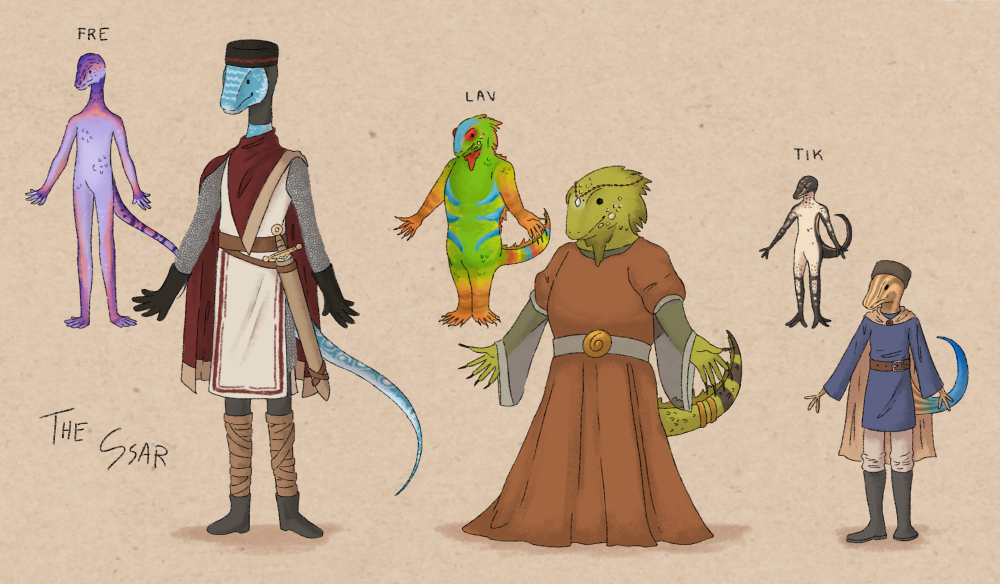
With scales covering their whole bodies, tails of varying lengths and snouted faces, the Ssar otherwise display a huge amount of variation. There are minimal distinctions between the two sexes, but significantly more in the traditional three 'morphs'. There was a time, in very ancient history, when the Ssar would control the spawning and choose to spawn a specific morph, but this has long been abandoned. These days the characteristics of the three morphs are all mixed up, and even if some traits appear dominant they rarely allow any sort of clean classification — the names below signify very broad categories.
The naming of morphs has variations in different cultures, but all derive from the same original roots
| Lav | broad, stocky, short-snouted |
| Tik | short, lithe, long-snouted |
| Fre | tall, thin, with larger skulls |
Much more significantly, the colouring of the skin and scales is a variation based on a lot of complicated environmental factors, which natural historians have discussed and debated at great length. Suffice to say, the different climates across the world lead to distinct colourations and appearances of Ssar born in a particular area. Thus, completely unrelated Ssar spawned in the same season, in the same geographical area may have similar or even identical colouration.
Social and Physical Traits
Ssar spawn in large groups of siblings and have close relations with those of the same spawning and even those before or after them. The Ssar are extremely social even beyond their families and tend to mix with other species, form large friendship groups and communities.
Ssar are cold-blooded, which results in two key characteristics: their metabolism is extremely efficient and Ssar can survive on very little food; they are entirely dependent on heat, however, and in the night time and in cooler conditions must rest and conserve their energy. Ssar families will often gather together early in the evening and share warmth by the fire to extend their day. Ssar can survive in colder climates, but in winter the question for Ssar families is often having enough fuel, rather than enough food.